meshr vs Teleport: network access vs. protocol proxy.
Teleport and meshr get compared a lot, but they solve different problems. Here's an honest look at what each actually does — and where they genuinely overlap.
Teleport isn't a mesh VPN.
It's a certificate-based access proxy / Privileged Access Management (PAM) platform. It has no network-layer connectivity of its own — it doesn't create tunnels or route general IP traffic. Instead, it proxies specific protocols (SSH, Kubernetes, databases, RDP, web apps) to resources you've explicitly registered with it. It can't carry arbitrary TCP/UDP traffic, VoIP, file sync, or anything outside its supported protocol list — that's out of scope by design. meshr is a private mesh network with SSH and session recording as one feature of that broader connectivity. The overlap between the two is real, but narrower than "same category."
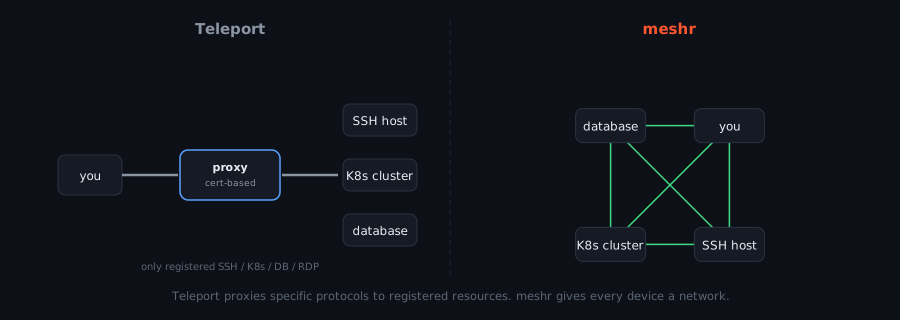
meshr vs Teleport, side by side.
Grounded in Teleport's own public docs and pricing pages.
| Teleport | meshr | |
|---|---|---|
| Category | Identity-aware access proxy / Privileged Access Management (PAM) | Full private mesh network (device-to-device + SSH) |
| Network-layer connectivity | None — proxies specific protocols to resources explicitly registered with it | Yes — arbitrary IP traffic across the mesh |
| Protocols proxied | SSH, Kubernetes, databases, RDP, web apps, cloud consoles | Not protocol-restricted — full mesh reachability, plus built-in SSH |
| SSH access | Certificate-based, ephemeral (replaces long-lived keys/tokens) | Certificate-based, built into every mesh connection |
| Session recording | Mature session replay with pause/rewind | Built-in session recording + audit logs |
| Machine & Workload Identity | Dedicated feature for CI/service accounts | Not published |
| SSO | Okta, GitHub, Google, AD, SAML, OIDC | OIDC-based SSO |
| Deployment | Cloud, self-hosted, FIPS, hybrid, edge | Cloud-hosted today — self-hosted build on the roadmap |
| Pricing | No self-serve pricing — custom quote, billed on MAU/MWI/TPR usage | Transparent self-serve pricing, published tiers |
| Free tier | Community Edition (AGPLv3) — free, but restricted to companies under 100 employees AND under $10M ARR | Free tier open to companies of any size or revenue |
Pricing and feature details as published by Teleport; subject to change on their end.
Where each one actually wins.
Different scope, different strengths — here's where Teleport genuinely has the edge, and where meshr does.
Where meshr wins
- meshr gives full private mesh connectivity — arbitrary traffic, not just specific protocols registered with an access proxy — with SSH, session recording, and audit logs as part of that broader package.
- Transparent, published self-serve pricing with no sales gate — Teleport requires a custom quote for every purchase.
- meshr’s free tier is open to companies of any size or revenue; Teleport’s Community Edition free tier is restricted to under 100 employees and under $10M ARR.
Where Teleport wins — honestly
- Purpose-built PAM depth: certificate-based ephemeral access spanning SSH, Kubernetes, databases, RDP, web apps, and cloud consoles in one unified access-governance layer.
- A more mature session-replay UX, with pause/rewind built out further than most VPN products’ recording features.
- Dedicated Machine & Workload Identity for CI pipelines and service accounts — a genuinely deeper feature set if your primary need is infrastructure access governance rather than network connectivity.
Already using Teleport for PAM?
meshr isn't a full Teleport replacement, so this isn't a rip-and-replace pitch. If your primary need is general network connectivity — not protocol-specific proxying to pre-registered resources — see how meshr adds a mesh with audited, session-recorded SSH alongside what Teleport already handles for infrastructure access.
curl -fsSL https://get.meshr.to/install.sh | sudo bashmeshr login -t <setup-key>meshr upmeshr vs Teleport FAQ.
Is meshr a replacement for Teleport?
Not fully, and we won’t pretend otherwise. Teleport is a certificate-based access proxy / PAM platform with no general network-layer connectivity — it only proxies specific protocols (SSH, Kubernetes, databases, RDP, web apps) to resources explicitly registered with it. meshr is a private mesh network: it gives you general device-to-device connectivity, and SSH with session recording is one part of that. If your primary need is deep PAM governance across many resource types, Teleport’s feature set is more specialized. If you need actual network connectivity plus audited SSH, meshr covers more ground in one product.
Does meshr do certificate-based access like Teleport?
meshr uses certificate-based device authentication and OIDC-based SSO for identity, and SSH access is certificate-based and session-recorded. It doesn’t offer Teleport’s protocol-specific proxying to Kubernetes clusters, databases, RDP, or web apps as pre-registered resources.
Why does Teleport not show self-serve pricing?
Teleport is billed on usage metrics (Monthly Active Users, Machine & Workload Identities, Trusted Protocol Requests) and requires a custom quote for every purchase — there’s no published self-serve price list. meshr publishes its pricing tiers directly.
Is Teleport’s free Community Edition really restricted by company size?
Yes — since a 2024 licensing change, Teleport’s Community Edition (now AGPLv3) is limited to organizations under 100 employees and under $10M ARR. meshr’s free tier has no such headcount or revenue restriction.
Can I use meshr and Teleport together?
Yes. Teams using Teleport for infrastructure PAM (Kubernetes, databases, RDP) sometimes still need general network connectivity between devices that Teleport doesn’t provide — that’s where meshr’s mesh fits, without needing to replace what Teleport already does well.
Get mesh connectivity + audited SSH.
Start with a free account. No credit card required.
# Get connected in 3 commands
$ curl -fsSL https://get.meshr.to/install.sh | sudo bash
$ meshr login -t <setup-key>
$ meshr up

✓ Connected! IP: 10.0.0.5
✓ DNS: my-server.meshr
✓ SSH: meshr ssh my-server